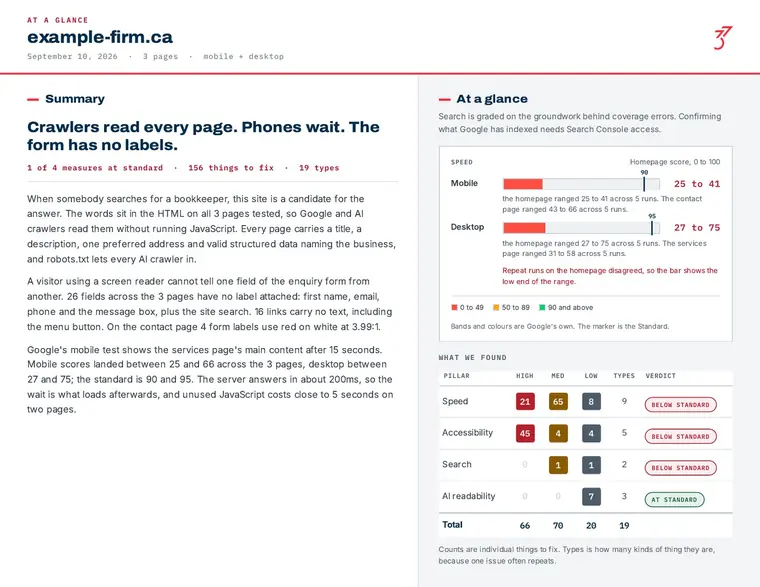
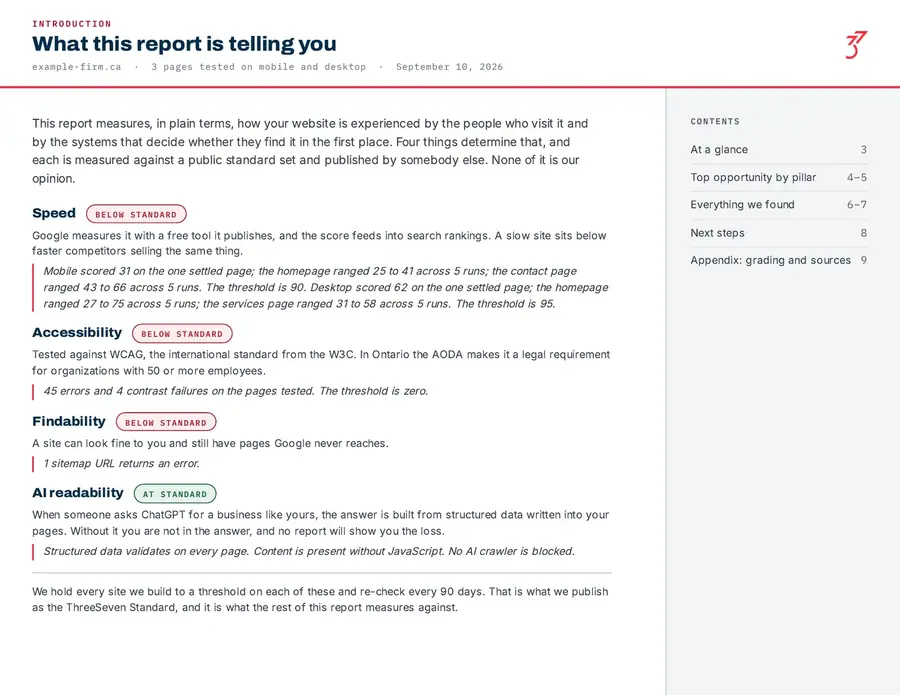
Whether Google sees complete, correct information about every page: titles, descriptions, a submitted sitemap, and properly sized images. When these are missing, Google writes its own listing for you, often badly, and your click-through suffers.
I set up Google Search Console on your domain, submit your sitemap, and confirm your pages are actually being indexed. Every quarter I check coverage again for pages that dropped out or started throwing errors. It’s the difference between assuming Google can read your site and knowing it can. This is the unglamorous plumbing of being found. It’s also the layer most sites lose first as pages get added over the years without anyone checking.
The same goes for AI tools. ChatGPT, Google’s AI answers and the rest read the text on your pages. Two things stop them: a robots.txt file that blocks their crawlers, often added by a plugin nobody remembers installing, and content that only appears after JavaScript runs. I check both. Neither promises an AI will recommend you. It makes sure nothing on your site stops one reading it.
Search Console is the one tool here that needs access to your Google account. I set it up when you join, and from then on this pillar is measured exactly as described above. A free report comes before that, so it checks your sitemap and the common causes of indexing problems instead.
Structured data isn’t graded. I still add it to every site I build, because Google and Bing use it to identify a business. Google says its AI features need no special markup. Microsoft says Copilot uses it; for other AI tools there’s little evidence either way, so a site doesn’t fail the Standard without it.