
Career Lion
Career and leadership branding. careerlion.com (opens in a new tab)

Website maintenance
I rebuild and host your site as part of the fee, with no upfront build fee, then keep it to a bar you can measure yourself.
Every 90 days I re-run those four tests and fix whatever slipped. If the site drops below any of them and I haven’t fixed it in 14 days, that month is free.
Everything in one monthly fee, from $229.
No add-ons, no hourly invoices, no “that’s extra.”
Website maintenance is the work that keeps a site running after it launches. Software updates so nothing is left exposed. Backups so a bad day can be undone. Security and uptime monitoring so someone notices when the site goes down before your clients do. Hosting. And the small edits every business needs: new hours, a new team member, a changed fee, a page that no longer says what you do.
Every plan worth paying for covers those. Most stop there. They report on the work: updates applied, backups taken, uptime 99.9%. None of that tells you whether the site still loads fast on a phone, whether your contact form can be completed without a mouse, or whether Google has quietly dropped half your service pages.
Most plans check the work, not the result. That’s the gap this page is about.
This is the part a maintenance plan doesn’t do. Every 90 days I re-run the same four checks, measured with public tools you can run yourself, against a bar that’s written down, versioned and dated. That bar is the ThreeSeven Standard.
90 or better on mobile and 95 on desktop in Google PageSpeed Insights, taken as the median of three runs.
Zero detected errors in an automated WCAG 2.2 scan, plus a keyboard pass on every form. A scan catches about a third of what matters, so a clean scan isn’t a certificate.
Every page indexed in Google Search Console with zero coverage errors.
Valid structured data, content that reads without JavaScript, headings that make sense. This is what lets AI tools work out what your firm does.
The bar is public, so you can hold me to it. When it moves, it moves in public too: each new version takes effect at least 90 days after it’s published, and your site is brought up to it at no extra cost. Read the Standard, or see the grading rules the free report uses.
Same four tests. Run them yourself on Google’s and WebAIM’s public testers; the numbers will match. Or request the free Standards Report and I’ll run all four on your site.
Career and leadership branding. careerlion.com (opens in a new tab)
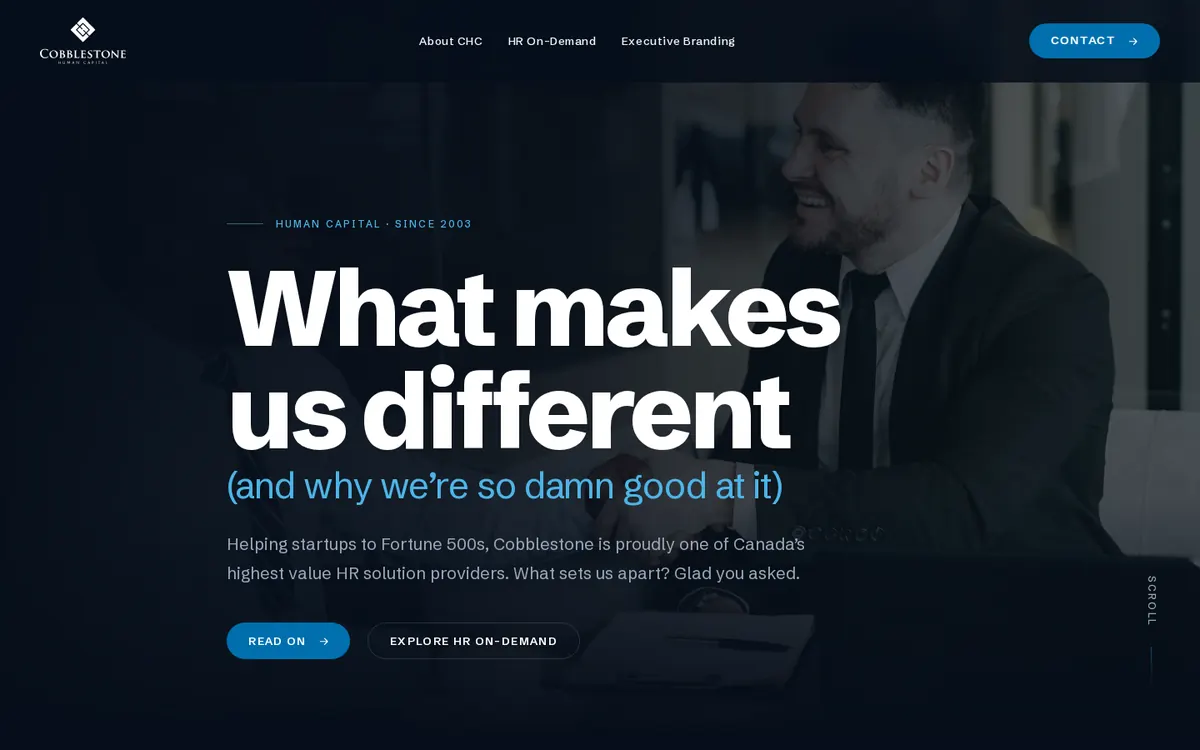
HR consulting and executive branding. cobblestonepath.com (opens in a new tab)
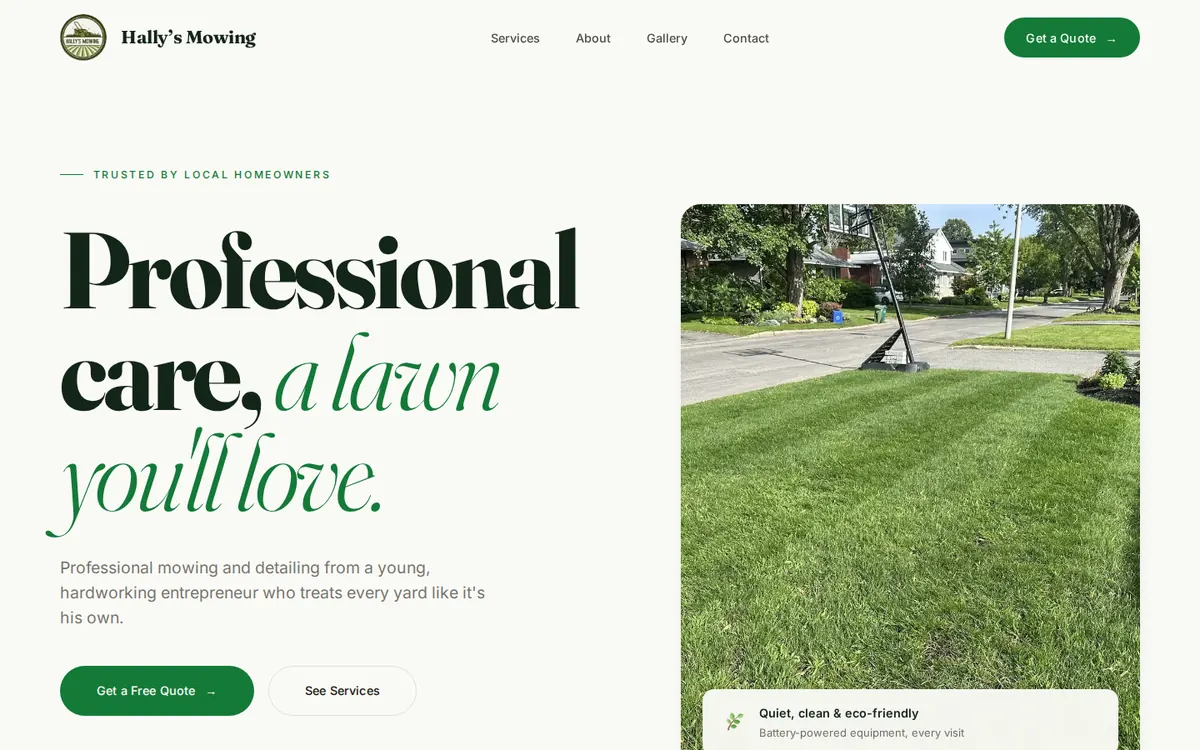
Residential lawn care, one person. hallysmowing.ca (opens in a new tab)
All four pillars passing on every site · verified 18 September 2026 · next check 17 December 2026
Every site on the service is listed, with its scores, on the Work page.
A site can be fully updated, backed up and online, and still be losing clients. None of the failures below shows up in an update log. These figures come from a September 2026 audit of 824 Ontario firm websites.
62 the median mobile score. Google calls 90 good.
Between meetings, on a weak signal, that’s a page that doesn’t finish loading before the prospect gives up.
77.5% fail basic text contrast.
Grey text on a white background looks refined on a designer’s screen and is hard to read for older clients and anyone on a phone in daylight.
28.7% have at least one form field with no label.
To anyone using a screen reader or a keyboard, that field doesn’t exist. The enquiry never arrives, and nothing tells you it didn’t.
49 firms force visitors onto an unencrypted page.
About 1 in 15 of the sites where both connection checks completed. These are practices collecting names, emails and phone numbers through their forms.
Every site in those figures was online. Updates keep the software current. They don’t check whether the result still meets today’s bar. If you run an accounting firm, the page on accounting firm websites has the full picture.
The Standard Guarantee
Most maintenance plans price the upkeep and bill everything else separately: the build as a project, then anything outside the plan by the hour. Here the build is inside the monthly fee, its setup cost spread over your first twelve months. The price depends on the size of your site, not on what’s included; every plan gets the same service. See all plans and every pricing question.
Every plan comes with the Standard Guarantee. If a 90-day check finds your site below the bar and I haven’t fixed it within 14 days, I refund that month. If a site is still below the bar 30 days after a failed check, or fails two checks in a row on the same pillar, the client can leave with no setup fee balance owed.
A failed check means a reproducible result, the median of at least three runs, because scores move a few points between runs on the same day. I won’t refund on noise, and I won’t hide behind it either. When the Standard itself changes, that isn’t a failure: I bring your site up to the new version at no extra cost.
What it doesn’t cover: things I don’t control, like scripts and widgets you add yourself or content published through the editor. And it never covers rankings. Nobody can honestly promise you a position in Google, and a guarantee that did would be worth nothing.
The usual model goes like this. A business pays for a site. It launches correct. Then it’s maintained: software updated, backups taken, the occasional edit. Five years later someone says it’s out of date, and the answer is a rebuild for $5,000 to $15,000.
The site wasn’t built wrong. It was built to the standard of the day it launched, and correct has a date attached to it. Since then Google changed what counts as fast, accessibility law caught up, and AI tools started reading pages differently. Maintenance kept the software current the whole time. Nobody was checking the result, so the gap grew until the only fix left was starting over.
Checking against a moving bar every 90 days means the gap never gets big enough to need a rebuild. Catching up happens a little at a time and is already in the fee. When the Standard changes, every site on the service is brought up to it. That’s the work you’d otherwise pay for in year five.
If you want to know how far your current site has drifted, the website expiry check counts every standard that changed since it was built, in two questions.
Any established service business whose website is supposed to bring in clients. That means a site that loads on a phone, that older clients and anyone on a keyboard can actually use, that Google has indexed, and that AI tools can read when someone asks them for a business like yours. If that’s what you need and you don’t have time to watch it yourself, this is for you. If you don’t have a site yet, start at the Standard instead.
It isn’t a fit for online stores, sites over 60 pages, or anyone who wants a self-serve portal and a ticket queue. You email a person here, and the person is me.
Yes. I rebuild it on the Standard and carry your look and content over, so the site you know stays recognizable while the engineering underneath changes. You see a private preview in the first couple of weeks and nothing goes live without your sign-off. Once I have your content, the target is two weeks to launch. Get in touch and tell me what you have.
“Nothing is broken” usually means nothing is visibly broken. A slow page, a form a screen reader can’t complete, or a service page Google stopped listing doesn’t throw an error. The site stays up and the prospect calls someone else. The 90-day check exists to find what you can’t see from your own desk.
I don’t promise rankings, and you should be wary of anyone who does. What I can promise is measurable: every page indexed, fast on a phone, readable by search engines and AI tools, with no coverage errors. That removes the technical reasons a site gets passed over. Where you rank still depends on your competitors, your content and your reputation.
Content requests are acknowledged within one business day and live within ten. Monitoring runs every day, so if the site goes down or something needs attention, I’m alerted rather than waiting for you to spot it. There’s no ticket portal: you email me, and I reply.
After a twelve-month minimum you’re month to month. Leave inside the first year and the unpaid part of the setup fee is due; stay the year and you never pay it. Your domain, content, brand and data are yours from day one. After your first year, if you leave, you get a full export of the site that any developer can pick up.
In Ontario, the AODA requires websites of private organizations with 50 or more employees to meet WCAG 2.0 Level AA, and organizations with 20 or more employees file accessibility compliance reports. Most small firms are below both thresholds, and I’ll tell you so rather than quote a penalty that doesn’t apply.
Every site I run is built to WCAG 2.2 and checked every 90 days anyway, because the visitors an inaccessible site turns away are the ones least likely to try again. If you’re over the threshold or holding a demand letter, you need a formal audit by a specialist, and I’ll point you to one.
Tell me about your site and what’s not working. I’ll reply within one business day, myself, with a straight answer about whether this is a fit. No call booked unless you want one, no sales sequence, no follow-up if you go quiet.
ThreeSeven Digital · https://three7.digital/website-maintenance/