
Free tool
Free website grader
See how Google's PageSpeed test scores your site on a phone and a desktop, and what each problem it finds means for your business.
Testing
- Waiting Google's phone test
- Waiting Google's desktop test
Google loads your page in a real browser for each test. It usually takes 10 to 30 seconds. Keep this page open.
Free Standards Report
Want the full picture?
The websites I build and run are held to the ThreeSeven Standard, a bar I publish: 90 or more on a phone and 95 or more on a desktop in Google's test, zero accessibility errors, every page in Google's index, and content AI tools can read. The free Standards Report measures your site against it.
- Three pages of your site
- Several runs of Google's test, with the middle result reported
- A second accessibility engine, WebAIM WAVE
- Search and AI readability checked as well as speed and accessibility
- The top finding in each area, and why it matters, in plain language
What lands in your inbox, from a real report:
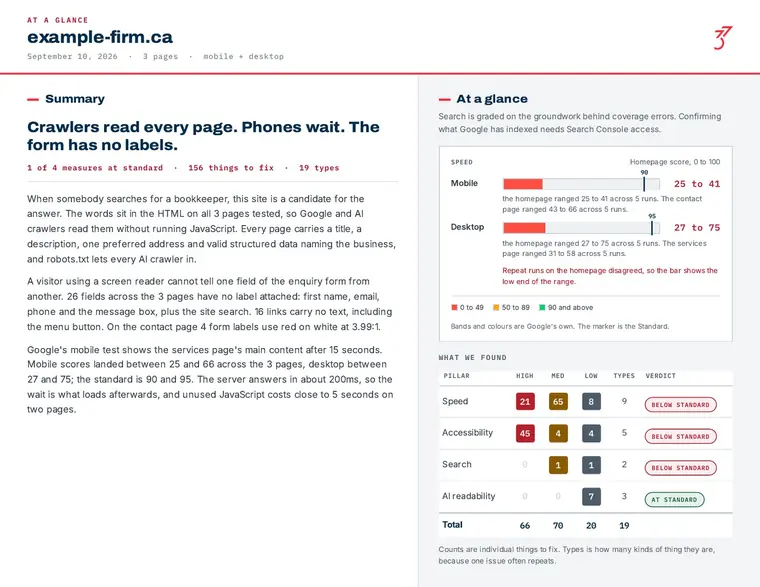
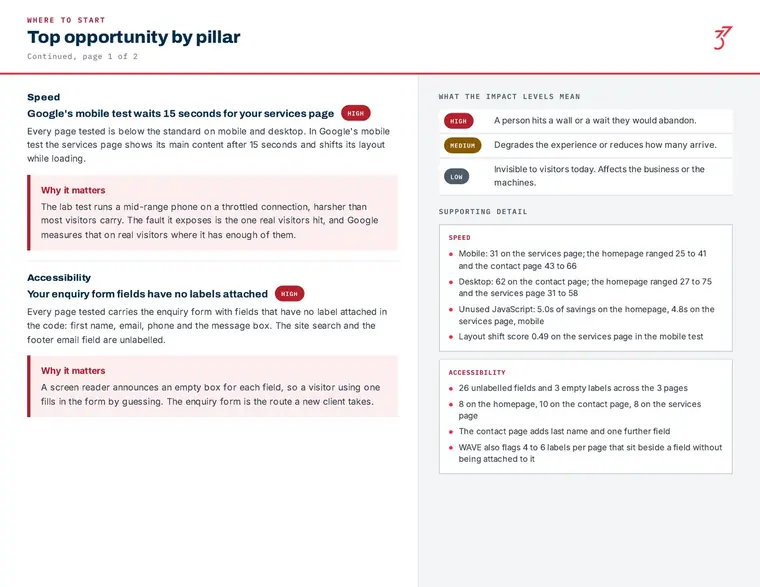
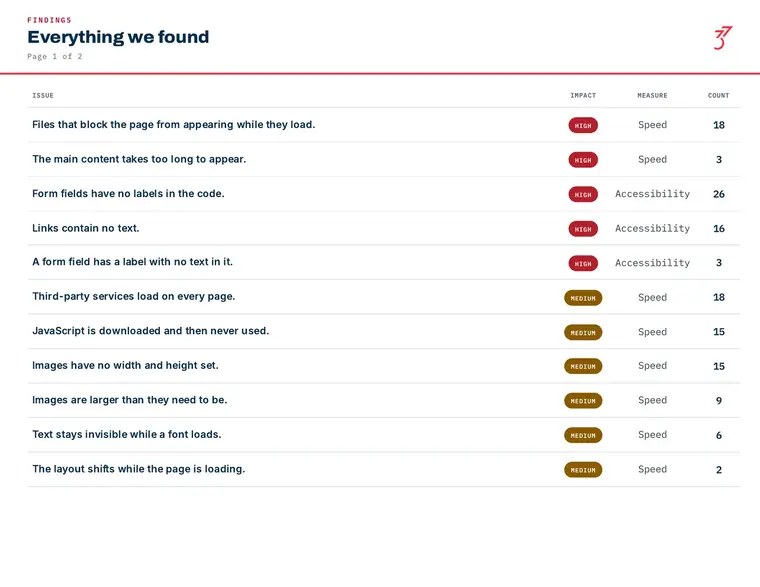
Free, usually in your inbox by the next business day.
What it checks
Google's own test, in plain English.
- Speed on a phone and a desktop, scored by Google's PageSpeed test.
- Accessibility, from Google's automated checks.
- Each problem explained in plain English, with why it matters to your business.
How it works, and its limits
- One run of Google's PageSpeed Insights test on the page you enter, phone and desktop.
- Scores move a few points between runs. Treat each result as a snapshot.
- It tests one page, not your whole site.
- Automated accessibility checks catch only part of real accessibility problems, roughly a third. A good score doesn't mean the site is accessible.
- It doesn't check search or AI readability. The free Standards Report does.
Why it matters
What this means for your firm.
Most people check a firm on their phone before they call. Often it's a referral, sitting in a parking lot or between meetings. If the page takes too long to appear, they don't wait and they don't tell you. They call the next name.
Accessibility works the same way: a contact form a screen reader can't use, or grey text that's unreadable in sunlight, loses people silently. None of this shows up when you look at your own site on a fast office connection.
That's why I use Google's own test. It's the same one your web person can run, so the results aren't my opinion, and they won't contradict what anyone else tells you.
Questions
Questions about the grader.
What it measures, what it leaves out, and how it differs from the full report.
What does the website grader check?
Speed and accessibility, using Google's PageSpeed Insights test on a phone and a desktop. I translate each problem Google finds into what it means for your business, so you don't need to be technical to read it.
Why only speed and accessibility?
Those are the two things Google's public test measures reliably from one run. Whether your pages are in Google's index, and whether AI tools can read your content, need more checks than a quick tool can do honestly. The free Standards Report covers both.
Does a good accessibility score mean my site is accessible?
No. Google's automated checks catch only part of real accessibility problems, roughly a third. A high score means none of the problems a machine can find were found. A person using a screen reader can still get stuck. In Ontario, the AODA requires private organizations with 50 or more employees to meet WCAG 2.0 AA.
Why is my website slow on a phone when it's fine on my computer?
Google tests phones on a slower connection and a slower processor than your office computer, because that's what many real visitors have. A page that feels instant at your desk can take several seconds on a phone. The phone score is the one to watch.
How is this different from the free Standards Report?
The grader is one run of Google's test on one page. The Standards Report tests three pages, runs Google's test several times and reports the middle result, adds a second accessibility engine (WebAIM WAVE), and checks search and AI readability. It lands in your inbox, usually by the next business day.
ThreeSeven Digital · https://three7.digital/website-grader/